

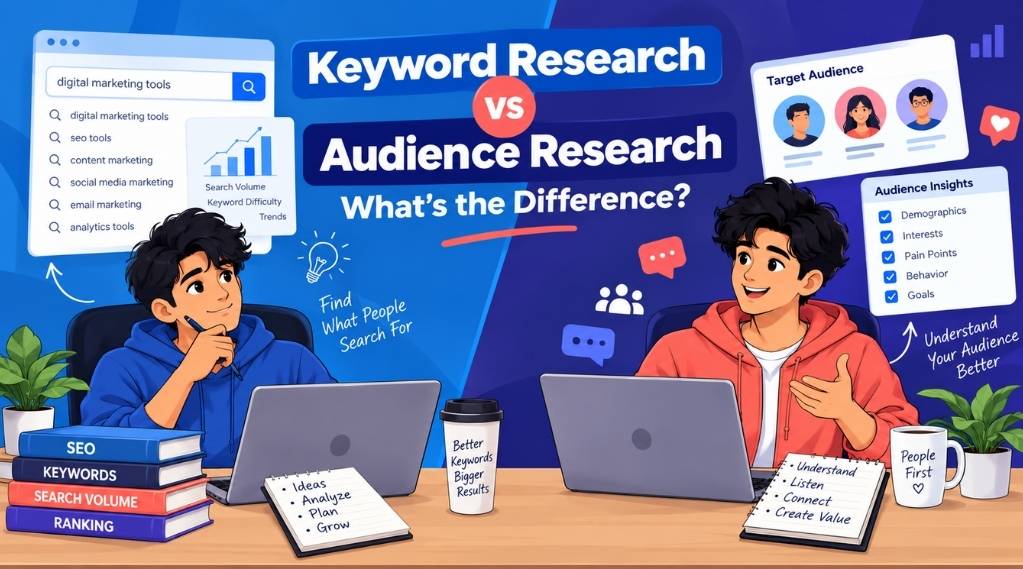
- What Is Keyword Research?
- What Is Audience Research?
- Keyword Research vs Audience Research: Key Difference
- Why Keyword Research Matters for SEO
- Why Audience Research Matters for SEO
- How Keyword Research and Audience Research Work Together
- How to Conduct Keyword Research
- How to Conduct Audience Research
- Which Comes First: Keyword Research or Audience Research?
- Common Mistakes Businesses Should Avoid
- Example: Keyword Research vs Audience Research for a Digital Marketing Agency
- How Sync Soft Solution Approaches SEO Research
- Conclusion
- Frequently Asked Questions
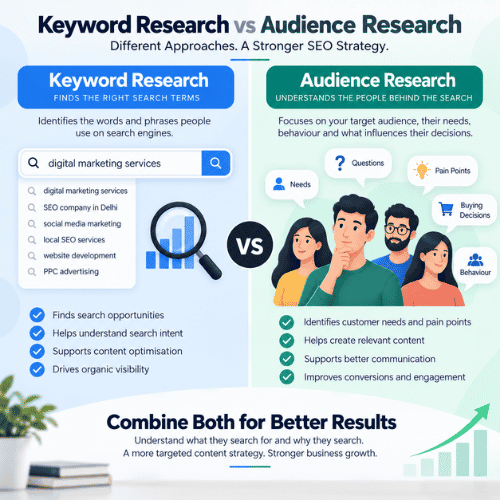
TL;DR: Keyword research identifies the terms people search for, while audience research explains who those people are, what they need, and why they search. A successful SEO strategy combines both to create relevant content, match search intent, attract qualified traffic, and improve conversions. Sync Soft Solution helps businesses use audience insights and keyword data to build focused, result-oriented SEO strategies.
Keyword Research vs Audience Research is an important comparison for businesses building an effective SEO and digital marketing strategy. Keyword research identifies the words and phrases people use on search engines, while audience research focuses on understanding who those people are, what problems they face, what information they need, and what influences their decisions. For businesses working with Sync Soft Solution, combining both approaches can create a more focused content strategy, improve search visibility, and connect organic traffic with genuine business opportunities.
What Is Keyword Research?
Keyword research is the process of identifying and analyzing search terms that potential customers use on search engines such as Google and Bing. It helps businesses understand what people are searching for and how those searches relate to their products, services, or information needs.
A professional keyword research process generally considers:
- Search relevance
- Search intent
- Search volume
- Competition
- Keyword difficulty
- Long-tail variations
- Location-based searches
- Commercial value
- Customer journey stage
For example, a business offering digital marketing services may identify keywords such as SEO company in Delhi, digital marketing services, website SEO services, or local SEO services.
However, selecting keywords only because they have high search volume does not always produce valuable traffic. The keyword should also match the audience, business objective, and content purpose.
What Is Audience Research?
Audience research focuses on understanding the people a business wants to reach. It examines their needs, interests, behavior, challenges, preferences, expectations, and purchasing decisions.
A business may use audience research to understand:
- Who its ideal customers are
- What problems they want to solve
- What questions they ask before purchasing
- What factors influence their decisions
- What concerns prevent them from taking action
- Which platforms they use
- What type of content they prefer
- How they describe their problems
For SEO, these insights are valuable because they provide context behind the search query.
A keyword tells you what someone searches for. Audience research helps explain why they are searching for it.
Keyword Research vs Audience Research: Key Difference
Keyword research and audience research serve different purposes, but neither should be treated as completely separate from the other.
| Keyword Research | Audience Research |
|---|---|
| Identifies search terms | Identifies target customers |
| Studies search behaviour | Studies customer behavior |
| Finds keyword opportunities | Finds customer needs and pain points |
| Focuses on search queries | Focuses on people behind the queries |
| Helps plan SEO content | Helps shape the content message |
| Analyses search intent | Analyses customer intent and motivation |
| Supports organic visibility | Supports relevance and engagement |
| Uses search data | Uses customer and behavioral insights |
The simplest way to understand the difference is:
Keyword research tells you what people type. Audience research helps you understand why they type it.
A strong SEO strategy uses both pieces of information.
Why Keyword Research Matters for SEO
Search engines need clear signals about the subject and purpose of a webpage. Relevant keywords help businesses identify the topics their potential customers are actively searching for.
Identifying Search Opportunities
Keyword research can reveal topics with meaningful search demand. Businesses can use these opportunities to develop blog posts, service pages, landing pages, FAQs, and supporting content.
Understanding Search Intent
A keyword can represent different types of intent.
For example:
Informational intent:
“What is technical SEO?”
Commercial intent:
“Best SEO company for small business”
Transactional intent:
“Hire SEO company in Delhi”
Navigational intent:
“Sync Soft Solution”
Understanding these differences helps businesses create content that matches the user’s expectations.
Building a Strong Content Strategy
Keyword research can also help organize content around broader topics and related search queries. Instead of creating isolated articles, businesses can develop topic clusters that cover a subject from multiple relevant angles.
Why Audience Research Matters for SEO
SEO is ultimately about connecting people with useful information. Audience research helps businesses understand what information is actually valuable to their target customers.
Understanding Customer Pain Points
Customers rarely search only for a product or service. They often search because they have a specific problem.
For example, a business owner may search for an SEO agency because:
- Website traffic has declined
- Competitors are ranking higher
- Leads from Google are limited
- Local visibility is poor
- Existing content is not generating results
- The website has technical SEO problems
Understanding these problems allows a company to create content that addresses the actual reason behind the search.
Creating More Relevant Content
Audience insights can influence the tone, format, depth, and subject of content.
A technical audience may prefer detailed explanations, while a business owner may want practical information about costs, timelines, results, and implementation.
Supporting Conversion-Focused Content
Audience research can reveal the questions customers ask before contacting a company. Businesses can address those questions through service pages, comparison articles, case studies, FAQs, and supporting content.
This makes SEO content more closely connected to the conversion journey.

How Keyword Research and Audience Research Work Together
The strongest approach is not keyword research versus audience research. It is the combination of both.
Consider a digital marketing company targeting small and medium-sized businesses.
Keyword research may identify:
“SEO services for small businesses“
Audience research may reveal that small business owners are concerned about:
- Limited marketing budgets
- Long SEO timelines
- Difficulty measuring results
- Lack of internal SEO expertise
- Local competition
- Generating qualified leads
The resulting content can address both the keyword and the customer’s actual concerns.
This creates a stronger connection:
Audience problem → Search behavior → Keyword → Search intent → Content → Solution
That process is more effective than writing an article around a keyword without understanding the person searching for it.
How to Conduct Keyword Research
A professional keyword research process can follow several stages.
1. Start With Business Goals
Identify the products, services, locations, and business objectives that SEO should support.
2. Identify Seed Keywords
Start with broad terms related to the business and expand them into relevant search variations.
3. Analyze Search Intent
Determine whether users are looking for information, comparing solutions, researching a company, or ready to make a purchase.
4. Find Long-Tail Keywords
Long-tail keywords often provide more specific context about the user’s requirements.
For example:
“SEO services” is broad.
“SEO services for small businesses in Delhi” provides considerably more context.
5. Group Related Keywords
Closely related keywords can be organized into topic groups to create comprehensive content instead of multiple repetitive pages.
6. Evaluate Business Relevance
Search volume should not be the only deciding factor. Relevance, intent, competition, and potential commercial value also matter.
How to Conduct Audience Research
Audience research can involve both quantitative and qualitative information.
Study Existing Customers
Customer conversations, inquiries, reviews, feedback, and support requests can reveal recurring problems and questions.
Analyze Website Behavior
Website analytics can provide insights into which pages attract visitors, how users navigate the website, and where they leave.
Review Search Queries
Search performance data can show the actual queries bringing visitors to a website. These queries can reveal unexpected customer interests and information needs.
Study Competitors
Competitor websites can provide useful clues about the audiences they target, topics they cover, and questions they attempt to answer.
Monitor Online Discussions
Forums, social platforms, review websites, and community discussions can help identify the language customers naturally use when describing their problems.
Which Comes First: Keyword Research or Audience Research?
There is no single rule for every campaign, but audience research can provide valuable direction before detailed keyword research begins.
Understanding the target audience first helps establish:
- Customer segments
- Common problems
- Search motivations
- Purchase barriers
- Relevant topics
- Customer journey stages
Keyword research can then turn these insights into measurable search opportunities.
For established websites, the process can also work in reverse. Existing keyword and search-query data can uncover new information about the audience.
Therefore, the most effective process is often iterative rather than strictly linear.
Common Mistakes Businesses Should Avoid
Choosing Keywords Only by Search Volume
High-volume keywords can be highly competitive or poorly aligned with the business.
Ignoring Search Intent
A page may rank for a keyword but still fail to satisfy the searcher’s purpose.
Creating Content for Everyone
Content aimed at everyone often becomes too generic. A defined audience allows for more specific messaging.
Using Industry Language Instead of Customer Language
Customers may describe a problem differently from industry professionals. Audience research helps bridge this gap.
Publishing Content Without a Business Objective
Not every article needs to sell directly, but important content should contribute to visibility, trust, engagement, or conversion.
Treating SEO and Audience Research as Separate Activities
SEO teams can get better results when search data and customer insights are considered together.

Example: Keyword Research vs Audience Research for a Digital Marketing Agency
Suppose a business targets the keyword:
“Digital Marketing Company in Delhi”
Keyword research helps identify related searches such as
- digital marketing agency in Delhi
- SEO company in Delhi
- digital marketing services in Delhi
- best SEO agency in Delhi
- social media marketing company in Delhi
Audience research adds another layer.
The target business owner may want to know:
- Which services are included?
- How does SEO generate leads?
- How long does SEO take?
- What reporting is provided?
- Can the agency handle local SEO?
- What experience does the agency have?
- How is campaign performance measured?
This information can shape a more useful content strategy.
Instead of simply repeating the target keyword, the content can answer the questions that influence a potential customer’s decision.
How Sync Soft Solution Approaches SEO Research
Sync Soft Solution focuses on developing digital marketing strategies around both search behavior and audience needs. Keyword research helps identify relevant search opportunities, while audience research provides the context required to create useful and commercially relevant content.
A combined approach can help businesses:
- Identify valuable search opportunities
- Understand customer intent
- Develop relevant content topics
- Improve website visibility
- Build topical authority
- Target different stages of the customer journey
- Create stronger landing pages
- Improve the connection between SEO traffic and business goals
The objective is not simply to rank for more keywords. The objective is to attract the right audience with the right content at the right stage of their search journey.
Conclusion
Keyword Research vs Audience Research should not be viewed as a choice between two competing SEO techniques. Keyword research shows businesses what people search for, while audience research explains the needs and motivations behind those searches.
When these insights are combined, businesses can create content that is more relevant, targeted, and useful. The result is a stronger SEO strategy that focuses not only on rankings and traffic but also on attracting qualified visitors and supporting meaningful business outcomes.
For businesses looking to build a sustainable digital presence, Sync Soft Solution can use this combined approach to develop SEO strategies based on search data, audience needs, and clear business objectives.
Frequently Asked Questions
What is the difference between keyword research and audience research?
Keyword research identifies the search terms people use, while audience research studies the people behind those searches, including their needs, behavior, challenges, and motivations.
Is keyword research enough for SEO?
Keyword research is an important part of SEO, but it is not enough by itself. Audience insights and search intent help businesses create content that is genuinely relevant to potential customers.
Why is audience research important for content marketing?
Audience research helps businesses understand what their customers care about, what questions they have, and what problems they want to solve. This information supports more relevant and useful content.
Can audience research improve keyword selection?
Yes. Understanding the target audience can reveal the language, questions, problems, and search behaviors that should influence keyword selection.
Which is more important: keyword research or audience research?
Both are important for different reasons. Keyword research provides search-market data, while audience research provides customer context. Combining them produces a more informed SEO strategy.
How does Sync Soft Solution help with SEO?
Sync Soft Solution can help businesses develop SEO and digital marketing strategies that combine keyword research, audience understanding, content planning, website optimization, and search-intent analysis.